
Many of us have encountered various discussions in different forums about which is the best language for Machine Learning or its popular subfield Deep Learning (and usually the best ML library discussions are added to it). If you haven’t encountered it yet, don’t get too excited, you will soon. In my opinion, the most accurate answer to this question can be “it depends on the situation”. Also, Elon Musk’s tweet on February 2, 2020, was a good indicator of this.
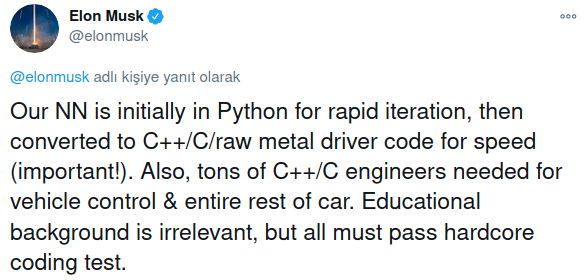
At this point, instead of making more noise on this topic, I will move on to what you can find in this article. The sections of the article:
1. Introduction
Especially when you want to use models with low latency/near real-time in the production phase, you encounter a few problems. I think the most critical problems are the speed/latency issues experienced in Python (I don’t mean that the language has a different claim) and problems arising from multi-process/thread usage (I mean the issues restricted by Global Interpreter Lock in object access). At this point, you may want to use some conveniences provided by a language like C++. I plan to write articles explaining how libraries like ONNX, TensorRT can be included in this regard. But in this article, I will talk about the LibTorch library provided by PyTorch to developers, which has a not too steep learning curve. This introductory article will be followed by separate articles explaining tensor operations, performing inference, and creating/training a model from scratch in C++.
The LibTorch library is the C++ API of PyTorch that entered our lives with PyTorch 1.0 version. It is used by Facebook for both research and production. Almost all features used on the Python side are also available in the C++ API. However, although a bit behind, I generally observe that the features used in PyTorch are added to the C++ API with a 1-version difference. In its own documentation, it emphasizes that we should evaluate this feature as “beta” and that PyTorch’s Python interface is more stable. However, I have been using it for a long time and I would like to state that I have not experienced any significant problems.
So what does LibTorch offer us:
- An interface to define machine learning models (equivalent to
torch.nn.Modulein Python), - A standard library for the most common modules (convolution, recurrent networks, batch normalization, etc.),
- Optimization API (SGD, Adam, etc.),
- Data sets and data pipelines that allow parallel processing on CPU cores,
- Ability to automatically parallelize models on GPU (
torch.nn.parallel.DataParallel), - Ability to easily use C++ models in Python,
- Use of TorchScript JIT compiler,
- ATen (basic tensor interface) and Autograd API (API that automatically calculates gradients on the computational graph).
You can reach the list and definitions of the components it offers from its documentation.
2. Usage Scenarios
So what can be the usage scenarios of LibTorch in C++?
- In my opinion, first of all, in the production phase, a model that is completely developed, trained, and saved in Python can be read and inference can be performed directly. Meanwhile, you can use advantages like multi-process/thread usage, low latency. I will cover its use for direct inference in the 3rd article of this series. Of course, you will be able to find different comparisons in that article.
- The model can be created/trained from scratch in C++. In the 4th article of the series, I will write and train the model from scratch in C++.
- You can write your own extensions on PyTorch.
3. Installation
There are two options for installation:
-
Download the compiled library:
-
Click on the link.
-
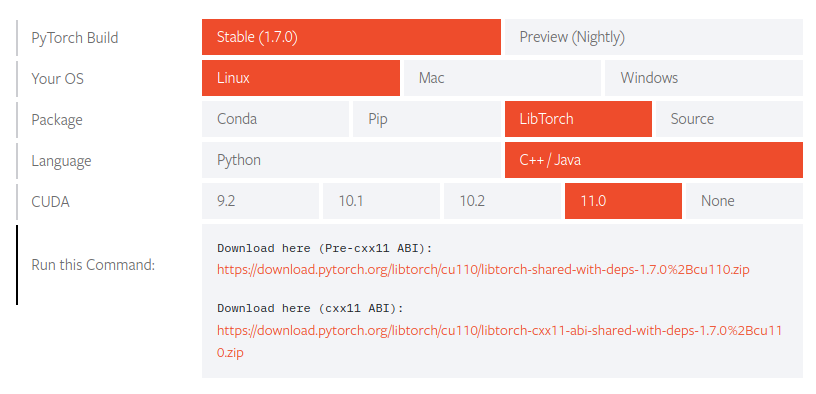
First click on the Stable link, then on the operating system link you use, then on the LibTorch link, then on the C++/Java link, and finally on the CUDA version link for GPU or None link if you will only use CPU, and download the file link that comes and copy its contents to any directory you want.
-
-
Compile from source code: It can be a bit troublesome (actually quite troublesome). But personally, this is my preference. Clone the GitHub repo and follow the necessary steps (I skip this section so it doesn’t get too long, but I can dedicate an article to this in the future).
4. Hello LibTorch
What I will explain in this article series will include using Clion as the development editor and the cmake tool on Linux operating system, but you can adapt the same procedures to your own operating system and compilation tool. Let’s start and first create a file named CMakeLists.txt and add the following content:
cmake_minimum_required(VERSION 3.17) # You can use your current cmake installation as long as the cmake version is at least 3.0
project(libtorchHelloWorld)

set(CMAKE_CXX_STANDARD 14)

find_package(Torch 1.7.0 REQUIRED) # Currently the available version is 1.7.0, correct this if you use a different version
set(CMAKE_CXX_FLAGS "${CMAKE_CXX_FLAGS} ${TORCH_CXX_FLAGS}")

add_executable(libtorchHelloWorld main.cpp)
target_link_libraries(libtorchHelloWorld ${TORCH_LIBRARIES})
Now let’s add our source codes in main.cpp:
#include <iostream>
#include <torch/torch.h>

int main() {
    torch::Tensor randTensor = torch::rand({2, 3});

    std::cout << "Hello LibTorch\n" << "Torch Tensor: " << randTensor << "\n";
}
And let’s create a directory to contain the compilation outputs and start compiling in it (-DCMAKE_PREFIX_PATH=/absolute/path/libtorch the path you specify should be the directory where you copied the content from the installation section):
$ mkdir build
$ cd build
$ cmake -DCMAKE_PREFIX_PATH=/absolute/path/libtorch ..
$ cmake --build . --config Debug
Now let’s run our compiled file and fulfill the Hello World classic:
$ ./libtorchHelloWorld
Hello Libtorch
Torch Tensor:  0.6147  0.6752  0.8963
 0.5627  0.4836  0.5589
[ CPUFloatType{2,3} ]
Now let’s take a closer look at the API by looking at this short application. First, the torch/torch.h header file contains the torch/all.h header file that includes all other header files of LibTorch:
#pragma once

#include <torch/all.h>

#ifdef TORCH_API_INCLUDE_EXTENSION_H
#include <torch/extension.h>

#endif // defined(TORCH_API_INCLUDE_EXTENSION_H)
If we examine the torch/all.h header file, we see that we have all the necessary header files. At this point, we have seen that we do not need any other header file besides the torch/torch.h header file:
#pragma once

#include <torch/cuda.h>
#include <torch/data.h>
#include <torch/enum.h>
#include <torch/jit.h>
#include <torch/nn.h>
#include <torch/optim.h>
#include <torch/serialize.h>
#include <torch/types.h>
#include <torch/utils.h>
#include <torch/autograd.h>
Actually, as a tip, if I say that when using PyTorch, you mostly write valid code for the C++ API by changing the . operator you use to ::, I don’t think it would be too misleading. Therefore, the variable named randTensor we defined in the main function is an instance of the torch.tensor class we are familiar with from the Python API. I will examine this class in more detail later.
torch::Tensor randTensor = torch::rand({2, 3});
With the above code, we obtain a tensor filled with random values in the shape of 2, 3 by using one of the different overloads of the rand function defined in the torch namespace.
std::cout << "Hello LibTorch\n" << "Torch Tensor: " << randTensor << "\n";
In the above line of code, when randTensor is the right operand of the << operator, it calls the print function in the at namespace (this namespace contains the ATen library, which is the basic tensor library used by LibTorch and PyTorch) and writes the tensor data, data type, and shape to the standard output. The torch::Tensor class provides a lot of things just like in the Python API. But they will be in the next article. We have reached the end of this article. As I mentioned in the introduction, this article will be followed by a series of articles. After writing the new sections, I will add their links under this article.
Other articles in the series: